- If you don't think the Vernon Wells trade was a terrible move by the Angels, read this. And this. And this.
- On a similar note, El Lefty Malo has a nice realistic take on the impact this has on the Giants' bad contracts (Aaron Rowand, Barry Zito).
- Bay City Ball looks at Giants first-round position players by WAR. Just another reminder of how special Buster Posey is.
- If you checked out the 2011 ZiPS projections, you probably already know this, but Brandon Belt is among the prospects that ZiPS projects to do well in the majors.
- Tune in tonight to the I-70 Baseball Radio Show for an exciting announcement regarding a new website.
- The San Francisco Giants are #1 on Reddit, among all baseball teams.
- Edgar Renteria will be making more money next year than Manny Ramirez. That's ridiculous.
- 20 days till pitchers and catchers report!

Showing posts with label Buster Posey. Show all posts
Showing posts with label Buster Posey. Show all posts
Monday, January 24, 2011
Notes: Vernon Wells, Buster Posey, Manny Ramirez

Saturday, January 22, 2011
Notes: Andrew Baggarly, Buster Posey, Pablo Sandoval
- Can't believe I hadn't known this: Giants beat-writer Andrew Baggarly is writing a book on the 2010 Giants. I recommend you pre-order it now, as it will definitely be a must-read.
- Tonight, Buster Posey received his Rookie of the Year Award at the BBWAA Awards Dinner. [picture]
- Pablo Sandoval is going to be in the Pepsi Home Run Derby in Venezuela..I'll keep you guys posted on it.
- Sam Miller of the Orange County Register made a pretty cool graphic illustrating the reactions of Jays fans and Angels fans following the Vernon Wells for Mike Napoli & Juan Rivera trade.
- If you're into sabermetrics, go check out the first-ever Beyond the Box Score podcast!
- The New York Times has a nice write-up on the Giants' return to New York. Also included: a cool picture of Buster Posey and Willie Mays together.
- As of Sunday, 22 days till pitchers and catchers report!
Wednesday, January 12, 2011
Notes: Wiffle Ball, Injuries, Promotional Schedule
- Jeff Zimmerman looked at the payroll amounts tied up in injured players in 2010. The Giants spent $12.3MM on players on the DL, good (or bad?) for 12.5% of their payroll, a fairly average mark.
- The Giants released their 2011 promotional schedule, and there's some really good stuff there if I do say so myself: World Series Ring Keychain, Buster Posey Pin, World Series Replica Trophy, World Champions Cap, Willie Mays Statue Replica, Tim Lincecum/Cody Ross/Buster Posey/Aubrey Huff bobbleheads, Madison Bumgarner T-Shirt, etc. My favorite though: Belt Buckle. I presume this is a Brandon Belt reference...
- If you have a Twitter account, you should follow Splashing Pumpkins so that you can get instant updates of posts and read my terribly unfunny puns.
- At this quiet time in the Giants offseason, this has been one of the biggest pieces of news recently: Dan Szymborski wrote an article for ESPN insider about the Giants' obstacles of repeating (subscription req'd). If you don't have an insider account like me, you should read the post about it by Otis Anderson of Bay City Ball, who does a good job of explaining it.
- 32 days till pitchers and catchers report!
- This wiffle-ball pitcher is nasty. I just have to post this here. (h/t Off Base Percentage)
Monday, January 3, 2011
A Distant Third Place?
In a recent ESPN post looking at the 2011 season, Rob Neyer wrote the following:
In my personal opinion, it is absolutely essential for a professional sports writer to back up his or her claims with significant statistical evidence. I am all for expressing radical opinions, but when I read ludicrous conclusions based on cherry-picked numbers, or in this case, no numbers at all, it simply ticks me off.
It is reasonable to believe that the Giants will miss the playoffs next year. A third place finish is also within the realm of possibility. But saying that they won't be competitive? Give me a break.
As Neyer points out, the Diamondbacks and the Padres are unlikely to be contenders in the NL West. While it seems that both teams could compete in the near future, we'll save that argument for another day. Eliminating those two leaves the Dodgers and the Rockies, who finished with 83 and 80 wins respectively. With this in mind, it's hard to imagine both teams leaving the Giants in the dust as predicted. Neyer cites various flaws with San Francisco's roster, but clearly, the same circumstances apply to both Los Angeles and Colorado as well.
First is the argument of "uncertainty" concerning rookies Buster Posey and Madison Bumgarner. While each has their own small blemishes, I can not find any clear signs pointing towards future struggles. Posey's below-average walk rate (6.8%) and Bumgarner's mediocre K/9 (6.97) are hardly worth mentioning. To me, a pair of sophomore slumps for these young stars seems possible, but not probable. On the contrary, as a Dodger fan, I would be worried about Matt Kemp's struggles hitting the fastball, as well as Jonathan Broxton's second half implosion. Similarly, Rockies fans should be concerned about Carlos Gonzalez's unsustainable .384 BABIP and Jhoulys Chacin's high walk tendencies.
Next, we get to the regression dispute. Is it really fair to say that Aubrey Huff will bring the Giants down when rival lineups feature aging veterans Todd Helton and Casey Blake? And while Andres Torres' breakout season seems like an anomaly, the attack on Jonathan Sanchez seems illogical. Luck is a factor throughout the game of baseball, and thus, every team has at least one pitcher that outperforms their peripherals, some more than others. Jon Garland (3.47 ERA, 4.35 xFIP) and Ubaldo Jimenez (2.88 ERA, 3.73 xFIP) are excellent examples of this.
Lastly is the trifle issue of the Giants changing shortstops. While Juan Uribe flashes more power and defensive prowess, Miguel Tejada brings durability and contact abilities to the table. The gap between these two is marginal compared to that of Manny Ramirez and an average left fielder. And while the Rockies did not lose any key players this offseason, they did part with solid contributors Miguel Olivo and Clint Barmes, who combined for 3.6 WAR in 2010.
I believe many will agree with me when I say that writers must look at the bigger picture if they wish to write a relevant article. It is obvious that the success of the Giants will be highly dependent on that of the Dodgers and the Rockies. When Rob Neyer chose to only examine the inadequacies of the Giants through unspecific generalizations, he failed to do the same for their main competition, thus destroying the foundations of his argument.
Which team will be the most surprising in 2011?
There's going to be a great deal of change in the National League West.
I don't expect the Diamondbacks' rebuilding efforts to pay off immediately and the Padres are obviously going to miss Adrian Gonzalez terribly, but it's hard to figure where everyone else ends up.
Still, the Giants might surprise a lot of people by dropping from world champions to third place, and perhaps even a not particularly competitive third place. In 2010, almost everything that could have gone well for them did go well, with a number of Giants enjoying surprisingly good seasons. If there's reason for optimism, it's tied almost solely to the assumption that Buster Posey and Madison Bumgarner will continue to thrive in their first full seasons. Will that be enough to balance the presumed regressions of Aubrey Huff, Andres Torres and Jonathan Sanchez, along with the departure of Juan Uribe (who's been replaced by Miguel Tejada)?
We'll know in eight or nine months.
In my personal opinion, it is absolutely essential for a professional sports writer to back up his or her claims with significant statistical evidence. I am all for expressing radical opinions, but when I read ludicrous conclusions based on cherry-picked numbers, or in this case, no numbers at all, it simply ticks me off.
It is reasonable to believe that the Giants will miss the playoffs next year. A third place finish is also within the realm of possibility. But saying that they won't be competitive? Give me a break.
As Neyer points out, the Diamondbacks and the Padres are unlikely to be contenders in the NL West. While it seems that both teams could compete in the near future, we'll save that argument for another day. Eliminating those two leaves the Dodgers and the Rockies, who finished with 83 and 80 wins respectively. With this in mind, it's hard to imagine both teams leaving the Giants in the dust as predicted. Neyer cites various flaws with San Francisco's roster, but clearly, the same circumstances apply to both Los Angeles and Colorado as well.
First is the argument of "uncertainty" concerning rookies Buster Posey and Madison Bumgarner. While each has their own small blemishes, I can not find any clear signs pointing towards future struggles. Posey's below-average walk rate (6.8%) and Bumgarner's mediocre K/9 (6.97) are hardly worth mentioning. To me, a pair of sophomore slumps for these young stars seems possible, but not probable. On the contrary, as a Dodger fan, I would be worried about Matt Kemp's struggles hitting the fastball, as well as Jonathan Broxton's second half implosion. Similarly, Rockies fans should be concerned about Carlos Gonzalez's unsustainable .384 BABIP and Jhoulys Chacin's high walk tendencies.
Next, we get to the regression dispute. Is it really fair to say that Aubrey Huff will bring the Giants down when rival lineups feature aging veterans Todd Helton and Casey Blake? And while Andres Torres' breakout season seems like an anomaly, the attack on Jonathan Sanchez seems illogical. Luck is a factor throughout the game of baseball, and thus, every team has at least one pitcher that outperforms their peripherals, some more than others. Jon Garland (3.47 ERA, 4.35 xFIP) and Ubaldo Jimenez (2.88 ERA, 3.73 xFIP) are excellent examples of this.
Lastly is the trifle issue of the Giants changing shortstops. While Juan Uribe flashes more power and defensive prowess, Miguel Tejada brings durability and contact abilities to the table. The gap between these two is marginal compared to that of Manny Ramirez and an average left fielder. And while the Rockies did not lose any key players this offseason, they did part with solid contributors Miguel Olivo and Clint Barmes, who combined for 3.6 WAR in 2010.
I believe many will agree with me when I say that writers must look at the bigger picture if they wish to write a relevant article. It is obvious that the success of the Giants will be highly dependent on that of the Dodgers and the Rockies. When Rob Neyer chose to only examine the inadequacies of the Giants through unspecific generalizations, he failed to do the same for their main competition, thus destroying the foundations of his argument.
Thursday, December 30, 2010
Notes
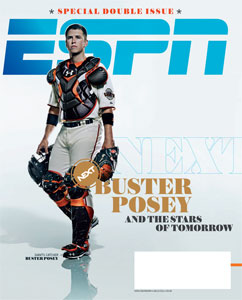
- Buster Posey will be featured on the cover of a special double-issue of ESPN The Magazine. Buster Olney has written a great article about Posey...check it out here.
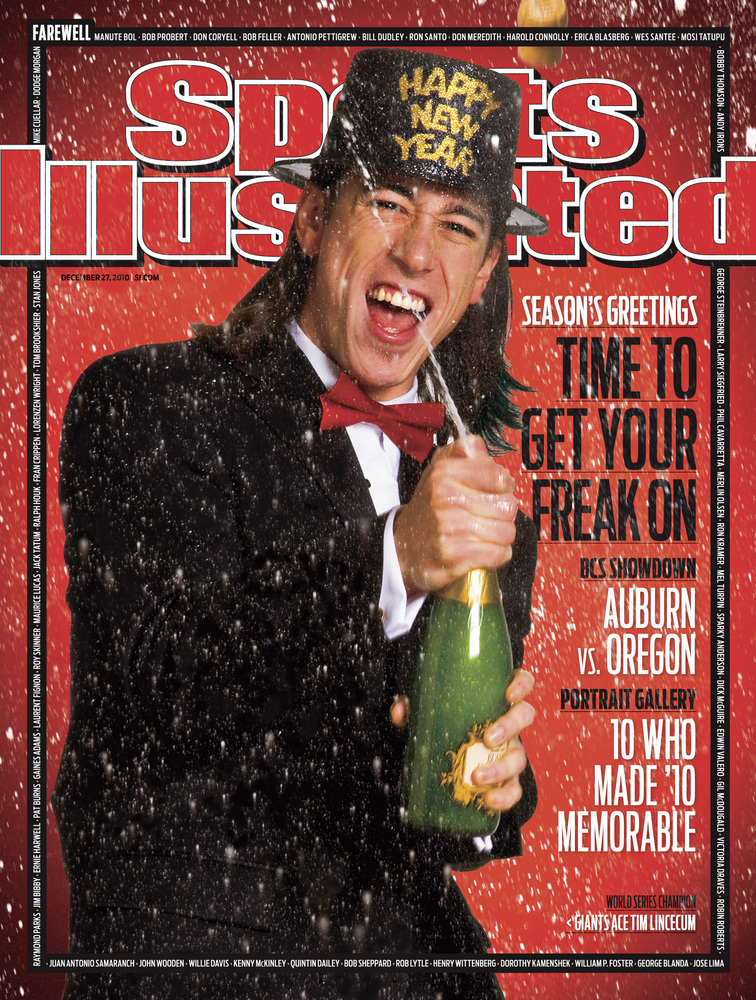
- In other magazine cover news, Tim Lincecum was featured on the cover of Sports Illustrated's year-end issue.
- Triples Alley has a nice post about how the Giants induce the fewest groundballs in the majors (242 GB below average per year) and thus, infield defense isn't as important for the Giants as it would be for a team like the Cardinals. It's comforting to know this, as the left side of the Giants' infield, Miguel Tejada and Pablo Sandoval, has mediocre defensive range.
- Kruk and Kuip are close to signing six-year extensions as the Giants' broadcasting duo.
- Roberto Alomar and Bert Blyleven were named today as the recommended 2011 Hall of Fame class by the Baseball Bloggers Alliance.
Wednesday, December 29, 2010
Looking Back at the 2010 Giants Projections
To say that 2010 was a season full of surprises would be an understatement: Pablo Sandoval and Tim Lincecum had disappointing sesasons; Mark DeRosa was injured after playing in only 26 games; Andres Torres and Aubrey Huff played far beyond expectations, putting up all-star caliber numbers; and Buster Posey had no trouble whatsoever in adjusting to the majors, becoming an elite catcher from day one (his debut). Lastly, the Giants picked up some phenomenal players on the way, namely Cody Ross, Javier Lopez, and Pat Burrell. Now that we've looked at (and made) projections for the 2011 season, I thought it'd be fun to take a look back at how certain Giants were expected to perform in 2010 (and compare it to their actual performance). This will give context to how surprising 2010 really was. For the purposes of this, I'll use ZiPS projections, one of the most well-respected projection systems out there. If you want to take a look at the 2010 ZiPS projections, they are available here.
Pablo Sandoval
Projected - .320/.368/.516; OPS+ 130
Actual - .268/.323/.409; OPS+ 95
Aubrey Huff
Projected - .270/.330/.448; OPS+ 102
Actual - .290/.385/.506; OPS+ 138
Aaron Rowand
Projected - .273/.335/.431; OPS+ 100
Actual - .230/.281/.378; OPS+ 75
Buster Posey
Projected - .263/.343/.398; OPS+ 95
Actual - .305/.357/.505; OPS+ 129
Freddy Sanchez
Projected - .296/.331/.414; OPS+ 95
Actual - .292/.342/.397; OPS+ 98
Edgar Renteria
Projected - .280/.336/.388; OPS+ 90
Actual - .276/.332/.374; OPS+ 90
Juan Uribe
Projected - .269/.311/.442; OPS+ 95
Actual - .248/.310/.440; OPS+ 99
Andres Torres
Projected - .254/.315/.397; OPS+ 86
Actual - .268/.343/.479; OPS+ 119
As can be seen from these comparisons, which look at only eight of the Giants, there were many surprises. Torres, Huff, and Posey far exceeded expectations; on the other hand, Rowand and Sandoval far underperformed. All in all, the Giants ended up playing much better than expected, taking home a World Series trophy with an offense that, before the season began, was the subject of ample criticism.
Pablo Sandoval
Projected - .320/.368/.516; OPS+ 130
Actual - .268/.323/.409; OPS+ 95
Aubrey Huff
Projected - .270/.330/.448; OPS+ 102
Actual - .290/.385/.506; OPS+ 138
Aaron Rowand
Projected - .273/.335/.431; OPS+ 100
Actual - .230/.281/.378; OPS+ 75
Projected - .263/.343/.398; OPS+ 95
Actual - .305/.357/.505; OPS+ 129
Projected - .296/.331/.414; OPS+ 95
Actual - .292/.342/.397; OPS+ 98
Projected - .280/.336/.388; OPS+ 90
Actual - .276/.332/.374; OPS+ 90
Juan Uribe
Projected - .269/.311/.442; OPS+ 95
Actual - .248/.310/.440; OPS+ 99
Andres Torres
Projected - .254/.315/.397; OPS+ 86
Actual - .268/.343/.479; OPS+ 119
As can be seen from these comparisons, which look at only eight of the Giants, there were many surprises. Torres, Huff, and Posey far exceeded expectations; on the other hand, Rowand and Sandoval far underperformed. All in all, the Giants ended up playing much better than expected, taking home a World Series trophy with an offense that, before the season began, was the subject of ample criticism.
Monday, December 27, 2010
2011 Giants Hitting Projections
So far, Fangraphs has posted the Bill James projections and the Fans projections. I thought it'd be fun to project the slash lines and home run numbers of the Giants' (presumable) starting eight (along with our personal commentary on our projections). I'd love to hear input from readers...post your own projections in the comments, or simply gives us your take on our projections...
We're Giants fans, so our projections are probably biased, but whatever.
Buster Posey:
Aubrey Huff:
Freddy Sanchez:
Pablo Sandoval:
Miguel Tejada:
Pat Burrell:
Andres Torres:
Cody Ross:
Looking at the projections, it seems the Giants have five guys with decent potential to hit 20 HRs...they don't have any sluggers, but they have nice power throughout the lineup. It's certainly enough offense to support that stellar rotation (which we'll project some time in the near future).
We're Giants fans, so our projections are probably biased, but whatever.
Buster Posey:
- Bill James - .308/.370/.506; 21 HRs
- Fans - .304/.374/.483; 20 HRs
- Julian Levine - .310/.380/.500; 25 HRs...I don't expect much to change with Posey, with the exception of an improved walk rate.
- Zachary Chiang - .290/.360/.490; 20 HRs...More patience, less power. Might tire down the stretch.
Aubrey Huff:
- Bill James - .269/.348/.453; 19 HRs
- Fans - .282/.358/.456; 21 HRs
- Julian Levine - .280/.350/.460; 18 HRs...I expect a natural decline in Huff's numbers from his stellar 2009 campaign, but I think he'll remain solid. He won't be a major home run threat, especially playing in AT&T Park, and his walk rate will probably decline from his peak '09 season, but he'll still be an impact bat in the heart of the lineup.
- Zachary Chiang - .275/.360/.460; 20 HRs...Basically a repeat of last year, minus a scorching July.
Freddy Sanchez:
- Bill James - .285/.330/.401; 8 HRs
- Fans - .290/.336/.385; 6 HRs
- Julian Levine - .290/.340/.400; 7 HRs...I don't really expect Sanchez's numbers to change much at all from his '09 numbers. Rather, I expect his consistency to improve. He had a hot August that raised his numbers a bit, after he had had a prolonged slump; I expect fewer up's and down's in 2010.
- Zachary Chiang - .295/.340/.400; 10 HRs..Hoping he can improve on a career best walk rate.
Pablo Sandoval:
- Bill James - .308/.363/.492; 18 HRs
- Fans - .295/.345/.476; 19 HRs
- Julian Levine - .310/.375/.510; 20 HRs...Sandoval's a polarizing figure. Some say he'll play like he did in '10, which was rather mediocre and disappointing; others say he'll play like he did in '09 -- all-star caliber hitting. I lean towards the optimistic side. I think he'll hit for a high average with good power. AT&T Park will definitely take a few home runs away from him, so I expect a lot of doubles -- like 40-50.
- Zachary Chiang - .290/.330/.450; 20 HRs...Bounces back to somewhere between '09 and '10.
Miguel Tejada:
- Bill James -.279/.324/.415; 17 HRs
- Fans - .272/.311/.389; 13 HRs
- Julian Levine - .280/.320/.405; 12 HRs...low walk rate, doubles power, decent average.
- Zachary Chiang - .275/.320/.400; 15 HRs...Amazing comeback isn't that likely. Solid, if anything.
Pat Burrell:
- Bill James - .237/.351/.443; 20 HRs
- Fans - .255/.350/.440; 19 HRs
- Julian Levine - .250/.350/.440; 17 HRs...exceptional walk rate, good power.
- Zachary Chiang - .240/.320/.450; 20 HRs...Not much confidence after weak postseason performance.
Andres Torres:
- Bill James - .271/.340/.440; 14 HRs
- Fans - .270/.343/.420; 12 HRs
- Julian Levine - .270/.340/.460; 15 HRs..I'm a believer in Torres. In 740 PAs in 2009 and 2010, he posted an ISO of .223...I don't think my projected ISO of .190 is extremely optimistic.
- Zachary Chiang - .260/.330/.420; 10 HRs..A little bit low, but I think some pitchers will figure him out.
Cody Ross:
- Bill James - .265/.321/.444; 18 HRs
- Fans - .274/.335/.446; 19 HRs
- Julian Levine - .270/.330/.460; 20 HRs...Okay, I got a little crazy here. But I don't know. I feel like he has some legitimate power, and it will just come flowing out in 2010. Lots of doubles, and lots of home runs (yes, I just called 20 home runs "lots of home runs". Gee, I miss Barry Bonds...) I think the fact that he has decent speed will help give a little boost to his power numbers, as he'll stretch several singles into doubles.
- Zachary Chiang - .275/.320/.430; 15 HRs...Will be hard for him to meet unrealistic expectations.
Looking at the projections, it seems the Giants have five guys with decent potential to hit 20 HRs...they don't have any sluggers, but they have nice power throughout the lineup. It's certainly enough offense to support that stellar rotation (which we'll project some time in the near future).
Tuesday, December 21, 2010
Notes, notes, notes
- The Giants took home five GIBBYs (Greatness in Baseball Yearly Awards). They are voted by fans, media, front-office personnel, and former major-leaguers...
Tim Lincecum - Postseason MVP
Brian Wilson - Closer of the Year
Buster Posey - Rookie of the Year
Bruce Bochy - Manager of the Year
Brian Sabean - Executive of the Year
- Andres Torres is going to be the subject of a documentary. Very happy to hear this...his story is one of the better ones in baseball.
- Brian Wilson is a nominee for Sportsnation's First Annual Awesomest Dude of the Year Award.
- After the signing of Pat Burrell, Rob Neyer said this: "And at some point this winter they need to get better, somewhere." By his standards, the Giants haven't really done that. But ObsessiveGiantsCompulsive (I'm admittedly a little late in finding this post) answered Neyer's comments perfectly. Seriously. It's an awesome explanation of how the Giants have a good chance to win the NL West.
Saturday, December 18, 2010
The Giants and Baserunning
I recently got the 2011 Bill James Handbook (which I highly recommend, by the way), and one of the sections in the book is about 2010 Major League Baserunning. I was not surprised at all to find that the Giants were the second-worst baserunning team in the majors -- behind only the Kansas City Royals.
For context -- an average major leaguer went from first to third on a single 28% of the time; a very good baserunner will go from first to third on a single about 38% of the time; and a very slow runner will do it about 18% of the time.
The Giants went from first to third on a single 82 times in 297 chances for a rate of 27.6%...so they were one base below average.
Now, an average major league player scored from second on a single 58% of the time; a very good baserunner will score from second on a single around 70% of the time; and a very slow runner will score from second around 41% of the time.
The Giants scored from second on a single 100 times in 170 chances for a rate of 58.8%...so they were one base above average.
Lastly, an average major leaguer will score from first on a double 44% of the time; 62% is very good, 27% is very poor.
The Giants scored from first on a double 31 times in 84 chances for a rate of 36.9%...about six bases below average.
A player is credited with a base taken when they advance on a passed ball, a wild pitch, a sac fly, a defensive indifference, or a balk. The Giants had 167 bases taken, which was about six bases below average.
The Giants, meanwhile, were thrown out advancing 25 times -- tied for tenth-best in the majors, and were doubled off 17 times -- tied for the worst mark of any major league team.
In average, a player grounds into a double play (in a double play opportunity) 11% of the time. The Giants grounded into a major-league worst 157 double plays. They had 1135 GIDP opportunities, so that rate comes to about 13.8%, or 32 double plays below average.
Baserunning Gain comprises all of these statistics...it is "the total of all the types of extra baserunning advances minus the (triple) penalty for all the BR Outs compared with what would be expected based on the MLB averages"....BR Outs "include the sum of Outs Advancing, Doubled Offs, and when a runner is tagged out on the bases when another runner moves up on a Wild Pitch, Passed Ball, or scores on a Sacrifice Fly."
The Giants had 43 BR Outs and their BR Gain of -42 was the fifth-worst mark in the majors.
Meanwhile, the Giants had an SB Gain of -9, the absolute worst in the majors. SB Gain is based on the fact that stolen base attempts must be successful greater than about two thirds of the time to have a positive result on the number of runs scored. It is therefore "the number of bases stolen minus two times the number of caught stealing (SB Gain = SB - 2CS)." The Giants stole 53 bases (26 of which were stolen by Andres Torres), and were caught stealing 31 times, so that equates to 53-62 which is equal to -9.
The Giants had an overall net gain (SB Gain + BR Gain) of -51, trailing only the Kansas City Royals as the worst baserunning team.
Some stand-out individual Giants net gains:
- Andres Torres +28
- Nate Schierholtz +13
- Pablo Sandoval -27
- Aubrey Huff +8
- Edgar Renteria, Cody Ross (with Marlins and Giants), and Buster Posey +1
- Bengie Molina (with Giants and Rangers) -13
- Jose Guillen (with Royals and Giants) -25
It seems as though the Giants have moved in the wrong direction in fixing their baserunning problem, as Miguel Tejada had a net gain of -5, a bit worse than Rent's mark of +1. Jason Bartlett, a shortstop that I had wanted the Giants to go after, had a net gain of +21, markedly better.
Again, if you like obscure yet important statistics like this, I highly recommend that you get the Bill James 2011 Handbook.
Again, if you like obscure yet important statistics like this, I highly recommend that you get the Bill James 2011 Handbook.
Friday, December 17, 2010
Locking Up Buster Posey
Over the last few years, baseball has seen a dramatic shift in the importance of home-grown talent. While wealthy powerhouses such as the Yankees have the spending power to be annually competitive, the strength of other teams seems to fluctuate based on the success of their farm systems. Consequently, many executives have placed a greater emphasis on rewarding promising young players with long-term extensions, hoping to save millions down the road. In just the past month, both Troy Tulowitzki and Jay Bruce have scored mega-deals keeping them in their respective uniforms for the foreseeable future. Lengthy contracts such as these are certainly risky, but often justified, as younger players are often willing to sacrifice salary for financial security.
With a breathtaking rookie campaign, Buster Posey has solidified his status as a cornerstone player the Giants will look to build around for the next decade or so. Unless a catastrophe occurs, he will surely be offered a long-term extension within the next few years. Due to a controversial Triple A stint in 2010, Posey will not become a free agent until after the 2016 season. However, like Tim Lincecum, he will qualify as a "Super Two" player, giving him an extra year of arbitration eligibility. For more detailed information on Buster's service time, I recommend reading this excellent article. The logical time for a Posey extension is 2012 because it is the first year he will be eligible for the arbitration process. Furthermore, the departures of Barry Zito and Aaron Rowand will free up millions of dollars. With a rejuvenated payroll, money should not be a major obstacle compared to the length of the contract itself.
As a Giants fan, is tempting to suggest that Brian Sabean should lock up Posey for the rest of his career. However, doing so would create a significant risk for the entire organization. Posey is a gifted player, but his success is far from guaranteed, due to baseball's volatility. Catchers are especially vulnerable to the effects of the long, strenuous season, as the strain put on their legs makes significant injury more plausible. A lengthy contract to a catcher is considered risky, no matter what the price is.
Since Posey has inevitably been compared to Joe Mauer, it seems only logical to analyze Mauer's durability. Following his MVP campaign, Mauer signed a highly touted eight-year $184MM extension that takes him through his age 35 season. While he is an exceptionally talented player, pundits assert that this contract will eventually spell disaster for the Twins. Over the past five years, Mauer has averaged 114 games per season at catcher due to various injuries. He's also spent a significant chunk of time at DH, a luxury Posey won't have. Despite individual player differences, Mauer's lack of constancy on the field does not bode well for any team seeking to extend a young catcher for a long period of time.
Another warning can be found in the form of rookie Cleveland Indians catcher Carlos Santana. The young backstop displayed exceptional patience and power at the plate during his time in 2010. Unfortunately, his promising season was brought to an abrupt end when he was injured in a head-on collision at the plate. While Santana is expected to return for the 2011 season, it is impossible to predict how he will respond to the physical and mental effects of this alarming experience. This type of incident is always a risk with Posey, and if it was to occur in the upcoming years, it would severely cripple the Giants' hopes of contention.
While durability is difficult to predict, it is obvious that catchers are more injury-prone than other position players, especially as they age. They play in fewer games and can often fall into prolonged slumps due to fatigue. For this reason, the Giants must be cautious when planning out an extension in the coming years. If the success continues, Brian Sabean will feel pressured to reward his young catcher with an immense contract. At present time, it is too early to predict a reasonable amount of money and years for a player of Posey's talent. It is, however, important to remember that superstar catchers face unique limitations that are often easy to forget.
Tuesday, December 14, 2010
Random Musings...
I just have a couple of random things I feel that I need to say, which are not worthy of individual posts....
First off, great article on Bay City Ball about Velez. Seriously. It says everything there is to say about Velez. By the way, Bay City Ball is a great Giants blog to read if you're more statistically-inclined.
Also, what happened to FireSabean? FireSabean wasn't necessarily a popular guy -- when the Giants were enjoying much success, day after day I would hear Giants analysts disparaging him -- but I always respected him. Not because I felt he was entirely correct -- he was a bit extreme (for example, when the Giants won an extra-inning game, I recall him saying something like "The Giants should have been able to win that game in nine innings. This is an outrage. A real GM would build a team that can win in nine innings." But because he was steadfast in his beliefs. He dealt with a lot of criticism, yet continued to believe that Brian Sabean was a bad GM. I'm disappointed he's gone -- I feel he just gave up on his beliefs. History can't erase the fact that Sabean signed Aaron Rowand and Barry Zito to those atrocious contracts; and I feel too much credit was given to Sabes for the World Series title. Buster Posey, Madison Bumgarner, Tim Lincecum, Matt Cain, Jonathan Sanchez, Brian Wilson, etc. were there because of the Giants' scouting department, not Sabes. I don't care if Sabean has a scouting background -- he's given more credit than he deserves, and that's all that I'll say on the matter.
First off, great article on Bay City Ball about Velez. Seriously. It says everything there is to say about Velez. By the way, Bay City Ball is a great Giants blog to read if you're more statistically-inclined.
Also, what happened to FireSabean? FireSabean wasn't necessarily a popular guy -- when the Giants were enjoying much success, day after day I would hear Giants analysts disparaging him -- but I always respected him. Not because I felt he was entirely correct -- he was a bit extreme (for example, when the Giants won an extra-inning game, I recall him saying something like "The Giants should have been able to win that game in nine innings. This is an outrage. A real GM would build a team that can win in nine innings." But because he was steadfast in his beliefs. He dealt with a lot of criticism, yet continued to believe that Brian Sabean was a bad GM. I'm disappointed he's gone -- I feel he just gave up on his beliefs. History can't erase the fact that Sabean signed Aaron Rowand and Barry Zito to those atrocious contracts; and I feel too much credit was given to Sabes for the World Series title. Buster Posey, Madison Bumgarner, Tim Lincecum, Matt Cain, Jonathan Sanchez, Brian Wilson, etc. were there because of the Giants' scouting department, not Sabes. I don't care if Sabean has a scouting background -- he's given more credit than he deserves, and that's all that I'll say on the matter.
Friday, November 26, 2010
Twins Win Bidding for Nishioka. Good News for Giants?
The Twins have won the bidding for Japanese middle-infielder Tsuyoshi Nishioka. This could be good news for the Giants, though.
Nishioka is said to be a better fit at second base, but the Giants are looking for a guy who can play shortstop well. In 2010, Nishioka posted a slash line of .346/.423/.482, but that was in all likelihood a big fluke, as he had a BABIP of .389... Before that, his previous best was .300/.366/.463...This article by Patrick Newman of Fangraphs basically likens Nishioka to Chone Figgins and Ryan Theriot, both of whom had unimpressive campaigns in 2010. So Nishioka isn't that great...throw in the fees for bidding and signing him to a contract, and it's definitely too high of a price to pay for a relatively weak shortstop.
The good news here is that this increases the likelihood that J.J. Hardy becomes available on the trade market. Hardy is one of the best shortstop options currently available: he's one of the best defensive shortstops in the majors, with a career UZR/150 of 11.0, and his bat has great offensive upside. From 2007-2008, Hardy belted a total of 50 home runs, although he hasn't come near those numbers in the past couple of seasons. However, his Bill James projections see him hitting .263/.328/.425 next year with 16 home runs. Throw in the superb defense that he'll inevitably provide, and that is an extremely valuable shortstop. Even with his .268/.320/.394 slash line in 101 games in 2010, he managed to produce 2.4 WAR. Project that over a full season and his 2010 worth is at 3.5-4.0 WAR. But he's projected to improve upon those numbers. At this point, the Giants probably wouldn't even have to give up much to get him.
His excellent defense and significant offensive potential warrant serious consideration. A lineup of Buster Posey, Aubrey Huff, Freddy Sanchez, J.J. Hardy, Pablo Sandoval, Mark DeRosa, Andres Torres, and Cody Ross is a legitimate offense. Pair that with the incredible rotation that the Giants have, and I think they have the tools to win many games. And that's not even considering the eventual call-up of Brandon Belt.
Nishioka is said to be a better fit at second base, but the Giants are looking for a guy who can play shortstop well. In 2010, Nishioka posted a slash line of .346/.423/.482, but that was in all likelihood a big fluke, as he had a BABIP of .389... Before that, his previous best was .300/.366/.463...This article by Patrick Newman of Fangraphs basically likens Nishioka to Chone Figgins and Ryan Theriot, both of whom had unimpressive campaigns in 2010. So Nishioka isn't that great...throw in the fees for bidding and signing him to a contract, and it's definitely too high of a price to pay for a relatively weak shortstop.
The good news here is that this increases the likelihood that J.J. Hardy becomes available on the trade market. Hardy is one of the best shortstop options currently available: he's one of the best defensive shortstops in the majors, with a career UZR/150 of 11.0, and his bat has great offensive upside. From 2007-2008, Hardy belted a total of 50 home runs, although he hasn't come near those numbers in the past couple of seasons. However, his Bill James projections see him hitting .263/.328/.425 next year with 16 home runs. Throw in the superb defense that he'll inevitably provide, and that is an extremely valuable shortstop. Even with his .268/.320/.394 slash line in 101 games in 2010, he managed to produce 2.4 WAR. Project that over a full season and his 2010 worth is at 3.5-4.0 WAR. But he's projected to improve upon those numbers. At this point, the Giants probably wouldn't even have to give up much to get him.
His excellent defense and significant offensive potential warrant serious consideration. A lineup of Buster Posey, Aubrey Huff, Freddy Sanchez, J.J. Hardy, Pablo Sandoval, Mark DeRosa, Andres Torres, and Cody Ross is a legitimate offense. Pair that with the incredible rotation that the Giants have, and I think they have the tools to win many games. And that's not even considering the eventual call-up of Brandon Belt.
Monday, November 22, 2010
NL MVP
Joey Votto won the NL MVP Award today, and it was well-deserved. He truly had an amazing season. Congratulations to Aubrey Huff, Buster Posey, and Brian Wilson, who finished 7th, 11th, and 13th respectively in NL MVP voting.
Wednesday, November 17, 2010
Brandon Belt
 In case you haven't heard of Brandon Belt, it's about time. He's an up-and-coming star in the Giants farm system that could very well be an integral part of the San Francisco Giants in 2011. As of now, he's playing in the Arizona Fall League, and enjoying success, as he did all season long...
An AFL title would just be the cherry on the top of what was an extraordinary debut season by any measurement. The 2009 fifth-round pick led the Minor Leagues with a 1.075 OPS (on-base plus slugging percentage). He finished second in batting average (.352) and on-base percentage (.455) while ending up fourth in RBIs (112) and seventh in slugging percentage (.620). He did it while playing across three levels, starting with Class A Advanced San Jose and finishing in Triple-A Fresno.Belt exhibits an impressive combination of power, contact, plate discipline, and a little bit of speed: in three levels of the minor leagues this year, he put up a .352/.455/.620 slash line, hit 23 home runs, walked 93 times in 595 plate appearances, and despite the fact that he's primarily a first baseman, he stole 23 bases.
It's easy to get caught up in the Brandon Belt hype, because the numbers he's produced consistently all season long are quite amazing. He also seems to be a very likable player...for example, here's what MLB.com writer Jonathan Mayo had to say about him:
Still, there's a humility in how Belt speaks about what's happened in 2010. He got the chance to play in the AFL Rising Stars Game -- the best of the best -- and showed some serious plate discipline (not to mention the respect of opposing pitchers) by drawing three walks. While Belt clearly feels he belongs in this rarified air, he does so without any sense of entitlement.
After thoroughly examining his 2010 season, I am going to make a bold claim. I think Brandon Belt will be the 2011 Rookie of the Year. I've even made a Facebook fan page...Granted, he'll have to receive adequate playing time -- even Posey cut it close in the Rookie of the Year by missing the first couple months of the season (it certainly gave competitor Jason Heyward the upper hand). But Belt appears to possess a unique skill-set that could easily see him as a starting first baseman in 2011.
I'll admit, I've gotten a little too caught up in the hype. But after seeing what Tim Lincecum, Buster Posey, and Madison Bumgarner have been able to do in the majors thus far, I believe Belt can emulate their success.
More about Brandon Belt to come...
More about Brandon Belt to come...
Monday, November 15, 2010
The Great Nate Debate
Guest post by Zachary Chiang.
Everyone knows that Buster Posey is a very talented young player. Another article praising his offensive prowess, defensive instinct, and unheralded leadership would simply be redundant. His highly anticipated debut did not disappoint, and his overall performance went above and beyond expectations. In the wake of the rookie catcher's amazing season, it is important to remember that not every transition to the big leagues is quite as smooth as his. Let's take a look at one of the quiet contributors to the Giants' championship run.
 At this point in his young career, Nate Schierholtz is best known for his brutal collision with the Chinese catcher in the '08 Beijing Olympics. Once thought to be the right fielder of the future, the Danville native was denied regular playing time with the big league club even after hitting .320/.363/.594 with 18 HRs in 93 games at the AAA level. While most Giants fans hold Nate's defensive skills in high regard, many seem to have varying opinions of his offensive ability. Some see him as a slap hitter with value only as a fourth outfielder, while others believe his star potential has been stunted by his limited playing time. Realistically, if Nate became more consistent, he would be a solid hitter, similar to David DeJesus.
A look at Nate's stats year by year turns up unimpressive results, but even with an abyssal line of .242/.311/.366 in 2010, there are bright spots to be picked out. Back on May 6th, he peaked out at .381/.458/.587 with a stellar 3 for 4 day. In June of '09, he hit .375 and people wanted to install him as high as third in the order. Even in his impressive '08 call up, he produced 1.2 WAR by pounding out 10 extra base hits in a mere 19-game stretch. With respect to small sample size, it is obvious that Nate is prone to streakiness. There are several months in which he hit under .200 with no sign of power whatsoever. However, it is appalling to think that the Giants could not find him regular playing time during their mediocre '07 and '08 seasons. Who knows what he could have accomplished as a regular the last three or four years?
Next year, Andres Torres and Cody Ross are locked into starting outfield roles. If Schierholtz were to land the last spot, Ross would be shifted to left as he was in the playoffs. Unfortunately, this scenario seems to be very improbable. Mark DeRosa will be back, and possibly return to left field. Aaron Rowand may have accepted a bench role this year, but it seems unlikely that he'll start the year there. Lastly, there still is the possibility of re-signing veteran leader Pat Burrell or picking up another free agent outfielder. As usual, 2011 will be an uphill battle for Nate. He must show management that he can play not only as well, but better than the veterans who will continue to block his way.
Do you have a strong opinion on Nate Schierholtz? We encourage you to comment below.
Everyone knows that Buster Posey is a very talented young player. Another article praising his offensive prowess, defensive instinct, and unheralded leadership would simply be redundant. His highly anticipated debut did not disappoint, and his overall performance went above and beyond expectations. In the wake of the rookie catcher's amazing season, it is important to remember that not every transition to the big leagues is quite as smooth as his. Let's take a look at one of the quiet contributors to the Giants' championship run.
 At this point in his young career, Nate Schierholtz is best known for his brutal collision with the Chinese catcher in the '08 Beijing Olympics. Once thought to be the right fielder of the future, the Danville native was denied regular playing time with the big league club even after hitting .320/.363/.594 with 18 HRs in 93 games at the AAA level. While most Giants fans hold Nate's defensive skills in high regard, many seem to have varying opinions of his offensive ability. Some see him as a slap hitter with value only as a fourth outfielder, while others believe his star potential has been stunted by his limited playing time. Realistically, if Nate became more consistent, he would be a solid hitter, similar to David DeJesus.
A look at Nate's stats year by year turns up unimpressive results, but even with an abyssal line of .242/.311/.366 in 2010, there are bright spots to be picked out. Back on May 6th, he peaked out at .381/.458/.587 with a stellar 3 for 4 day. In June of '09, he hit .375 and people wanted to install him as high as third in the order. Even in his impressive '08 call up, he produced 1.2 WAR by pounding out 10 extra base hits in a mere 19-game stretch. With respect to small sample size, it is obvious that Nate is prone to streakiness. There are several months in which he hit under .200 with no sign of power whatsoever. However, it is appalling to think that the Giants could not find him regular playing time during their mediocre '07 and '08 seasons. Who knows what he could have accomplished as a regular the last three or four years?
Next year, Andres Torres and Cody Ross are locked into starting outfield roles. If Schierholtz were to land the last spot, Ross would be shifted to left as he was in the playoffs. Unfortunately, this scenario seems to be very improbable. Mark DeRosa will be back, and possibly return to left field. Aaron Rowand may have accepted a bench role this year, but it seems unlikely that he'll start the year there. Lastly, there still is the possibility of re-signing veteran leader Pat Burrell or picking up another free agent outfielder. As usual, 2011 will be an uphill battle for Nate. He must show management that he can play not only as well, but better than the veterans who will continue to block his way.
Do you have a strong opinion on Nate Schierholtz? We encourage you to comment below.
A Closer Look at the Rookie of the Year Balloting
| Player Name, Team, WAR | 1st | 2nd | 3rd | Points |
|---|---|---|---|---|
| Buster Posey, San Francisco Giants 3.9 | 20 | 9 | 2 | 129 |
| Jason Heyward, Atlanta Braves 5.0 | 9 | 20 | 2 | 107 |
| Jaime Garcia, St. Louis Cardinals 3.2 | 1 | 1 | 16 | 24 |
| Gaby Sanchez, Florida Marlins 2.4 | 2 | 1 | 5 | 18 |
| Neil Walker, Pittsburgh Pirates 1.9 | 1 | 3 | ||
| Starlin Castro, Chicago Cubs 2.0 | 3 | 3 | ||
| Ike Davis, New York Mets 3.4 | 2 | 2 | ||
| Jose Tabata, Pittsburgh Pirates 2.0 | 1 | 1 | ||
| Jonny Venters, Atlanta Braves 1.7 | 1 | 1 |
As you can see, for the most part, the voting was consistent with the Wins Above Replacement each player produced. There are three exceptions, only two of which were significant differences.
The first exception was Buster Posey, who likely would've produced the most WAR had he played the entire season -- of course, it's not necessarily fair to assume this, but based on the way he played for most of the season, it's fair to say that he was the winner. If I was a Braves fan, I would probably complain that Heyward got snubbed. But since I'm a Giants fan, I can overlook Heyward's impressive walk rate and instead marvel at the fact that Posey hits with power to all sides of the field, all while calling a good game behind the plate.
Now, the second exception is really not that significant at all. Neil Wakler produced less WAR than Tabata and Castro, but his 1.9 is close enough to their respective 2.0s that it's not really a big deal.
The third exception, however, is probably the biggest snub. Ike Davis had the best UZR among first basemen (10.1) all while putting up a nice slash line of .264/.351/.440 with 17 home runs and a nice walk rate of 12%. This accumulated to 3.4 WAR, much better than that of Castro (2.0), Walker (1.9), and even Jaime Garcia.
Now, I'm not saying that the voting should have gone by WAR. Personally, I think Jaime Garcia deserved third place in the Rookie of the Year voting, stepping up out of nowhere as a very solid number three starter. However, Ike Davis was clearly overlooked. It's easy not to be impressed by his .264 batting average, but he had just one less home run than Heyward, and his walk rate (12%) is comparable to Heyward's rate of 14%. Not to mention that Davis had the second-best defense among first basemen.
I guess I would've wanted Davis to slip up their in the voting between Sanchez and Garcia. Are Sanchez's numbers really better than those of Davis?
Gaby Sanchez: .273/.341/.448, -0.1 UZR, 19 home runs.
Ike Davis: .264/.351/.440, 10.1 UZR, 19 home runs.
Their numbers are quite similar. I think Davis deserved more votes, however, due to his far superior defense.
As a Giants fan, however, I must point out the lack of recognition for Madison Bumgarner. It makes sense, I suppose, that he was left off the ballot, because he by no means deserves a third-place vote, second-place vote, or even first-place vote for his regular season performance among this stacked rookie class. However, if the ballot was given after the postseason, and was for the top five rookies, Bumgarner definitely deserved a nod.
Whatever. I can't complain. Buster Posey won, and rightfully so. I was admittedly nervous..It's hard not to be, with all the hype surrounding Jason Heyward (the J-Hey kid). But now Giants fans can finally sit back and reminisce about what's been possibly the greatest season in the San Francisco era of this Giants franchise. A Rookie of the Year Award for Buster Posey, and a World Series title.
BUSTER POSEY: 2010 ROOKIE OF THE YEAR

Sunday, November 14, 2010
Buster Posey v. Jason Heyward: 2010 Rookie of the Year
Tomorrow is the day. After one of the best seasons in the history of the Giants franchise -- a lot of the credit due to Buster Posey, of course -- the world will finally know whether or not Buster Posey is the Rookie of the Year. The Giants have been overlooked many times this season. They weren't expected to win the NL West. They weren't expected to win the NLDS. They weren't expected to win the NLCS. And most importantly, they weren't expected to win the World Series. When Gold Glove Awards were announced, the Giants once again were overlooked. Andres Torres, arguably the best defensive outfielder in the National League, was not given the award for his superb outfield defense. Instead, Carlos Gonzalez got it. It's easy to shake most of these off. It simply made the Giants World Series victory all the better -- the fact that they were considered underdogs; Andres Torres' not being granted a Gold Glove Award was more of a personal hit, because I, among many other Giants fans, felt that he deserved recognition for his work out there.
But tomorrow, the Baseball Writers' Association of America can make it all right. Their voting will be announced at 11 AM (Pacific time) on Monday. As we await this sacred announcement, I would like to take one last look at the 2010 seasons of Jason Heyward and Buster Posey.
Batting Average
Posey - .305
Heyward - .277
Walk Rate
Posey - 6.8%
Heyward - 14.6%
ISO
Posey - .200
Heyward - .179
K Rate
Posey - 13.5%
Heyward - 24.6%
HR/AB
Posey - 18/406
Heyward - 18/520
SB/CS
Posey - 0/2
Heyward - 11/6
WAR
Posey - 3.9
Heyward - 5.0
My biased opinion: Posey deserves the award. He is a better hitter -- better contact rate and better raw power (better ISO). To do that, on top of catching the best pitching staff in baseball is just remarkable. Catchers don't get enough respect, but what they do every day takes a real tear on their body. It requires intense focus and reaction time. Heyward has the upper hand in speed and his walk rate is quite impressive, but taking into account the fact that Posey is a catcher, I'd say Posey deserves the award.
Tomorrow, the Baseball Writers' Association of America can make it all right. They can reward Posey for one of the best rookie seasons of all time -- it's not very often that a rookie catcher leads their team to a World Series title, let alone the first World Series title for that franchise in over 50 years. For now, the demi-god known as Gerald Demp Posey III will have to wait to be honored.
NOTE: Keep in mind that WAR is a counting statistic, so the Heyward has better WAR because he played from day one, as opposed to Posey, who was held in the minors for the first two months of the season.
But tomorrow, the Baseball Writers' Association of America can make it all right. Their voting will be announced at 11 AM (Pacific time) on Monday. As we await this sacred announcement, I would like to take one last look at the 2010 seasons of Jason Heyward and Buster Posey.
Batting Average
Posey - .305
Heyward - .277
Walk Rate
Posey - 6.8%
Heyward - 14.6%
ISO
Posey - .200
Heyward - .179
K Rate
Posey - 13.5%
Heyward - 24.6%
HR/AB
Posey - 18/406
Heyward - 18/520
SB/CS
Posey - 0/2
Heyward - 11/6
WAR
Posey - 3.9
Heyward - 5.0
My biased opinion: Posey deserves the award. He is a better hitter -- better contact rate and better raw power (better ISO). To do that, on top of catching the best pitching staff in baseball is just remarkable. Catchers don't get enough respect, but what they do every day takes a real tear on their body. It requires intense focus and reaction time. Heyward has the upper hand in speed and his walk rate is quite impressive, but taking into account the fact that Posey is a catcher, I'd say Posey deserves the award.
Tomorrow, the Baseball Writers' Association of America can make it all right. They can reward Posey for one of the best rookie seasons of all time -- it's not very often that a rookie catcher leads their team to a World Series title, let alone the first World Series title for that franchise in over 50 years. For now, the demi-god known as Gerald Demp Posey III will have to wait to be honored.
NOTE: Keep in mind that WAR is a counting statistic, so the Heyward has better WAR because he played from day one, as opposed to Posey, who was held in the minors for the first two months of the season.
Links
Every week, I gather links to interesting baseball-related articles, photos, videos, graphs, etc. Enjoy...
This is the first edition, so it will have some pretty basic must-see links. So it's likely that you've seen some -- or maybe even all of these links. But it will get deeper as the weeks go by, so stay tuned.
This is the first edition, so it will have some pretty basic must-see links. So it's likely that you've seen some -- or maybe even all of these links. But it will get deeper as the weeks go by, so stay tuned.
- Madison Bumgarner apparently takes very little time in between pitches. He ranked 9th among NL pitchers with at least 500 pitches for the shortest time in between pitches.
- Visual Baseball is a very cool website which produces baseball-related charts and graphics. For example, here's a graphic showing how good the Giants were in 2010 in various categories relative to the other major-league teams.
- Joe Posnanski, a writer for Sports Illustrated, asked Yankees fans the question: "If you could trade Derek Jeter tomorrow to Florida for Hanley Ramirez, would you do it?" The results were pretty interesting.
- Here's an awesome San Francisco Giants 2010 playoff video complete with epic music and the most memorable moments.
- This is a pretty well-known website, so I doubt you haven't heard of it. But in the off-chance that you aren't aware of HitTrackerOnline, it's a must-see: it tracks every home run with graphs, distance data, links to videos of the home runs, etc.
- MLBTradeRumors explains why young starters are signed to contract extensions.
- I'm not sure if I've posted this on SplashingPumpkins before, but it's a classic. Buster Posey guns down a would-be basestealer then says "I ain't havin' it."
- I've definitely posted this here before, and you've most likely heard of it, but there's a Facebook fan page entitled "Brian Wilson Should Host SNL." Join the revolution.
- Whether you like it or not, Brian Wilson has gotten the second-widest strike zone in baseball over the last two years, behind Livan Hernandez.
If you know/have an interesting baseball-related link, by all means tell us about it.
Thursday, November 11, 2010
2010 Silver Slugger Awards
The 2010 Silver Slugger Awards were announced today. Like the Gold Glove Awards, voting is conducted by Major League coaches and managers:
AL
C Joe Mauer
1B Miguel Cabrera
2B Robinson Cano
3B Adrian Beltre
SS Alexei Ramirez
OF Jose Bautista
OF Carl Crawford
OF Josh Hamilton
DH Vladimir Guerrero
NL
C Brian McCann
1B Albert Pujols
2B Dan Uggla
3B Ryan Zimmerman
SS Troy Tulowitzki
OF Ryan Braun
OF Carlos Gonzalez
OF Matt Holliday
P Yovani Gallardo
Not a single San Francisco Giant took home a Silver Slugger Award, but unlike the Gold Glove Award, there was really no standout candidate for the Giants that deserved the award. Arguments could be made for Aubrey Huff and Buster Posey, possibly, but ultimately, I think the Silver Slugger Awards were given to the right players.
It'll be interesting to see if Posey wins the Silver Slugger next year, however, because beyond McCann, I don't really see much competition for the award at the catcher position.
AL
C Joe Mauer
1B Miguel Cabrera
2B Robinson Cano
3B Adrian Beltre
SS Alexei Ramirez
OF Jose Bautista
OF Carl Crawford
OF Josh Hamilton
DH Vladimir Guerrero
NL
C Brian McCann
1B Albert Pujols
2B Dan Uggla
3B Ryan Zimmerman
SS Troy Tulowitzki
OF Ryan Braun
OF Carlos Gonzalez
OF Matt Holliday
P Yovani Gallardo
Not a single San Francisco Giant took home a Silver Slugger Award, but unlike the Gold Glove Award, there was really no standout candidate for the Giants that deserved the award. Arguments could be made for Aubrey Huff and Buster Posey, possibly, but ultimately, I think the Silver Slugger Awards were given to the right players.
It'll be interesting to see if Posey wins the Silver Slugger next year, however, because beyond McCann, I don't really see much competition for the award at the catcher position.
Subscribe to:
Posts (Atom)